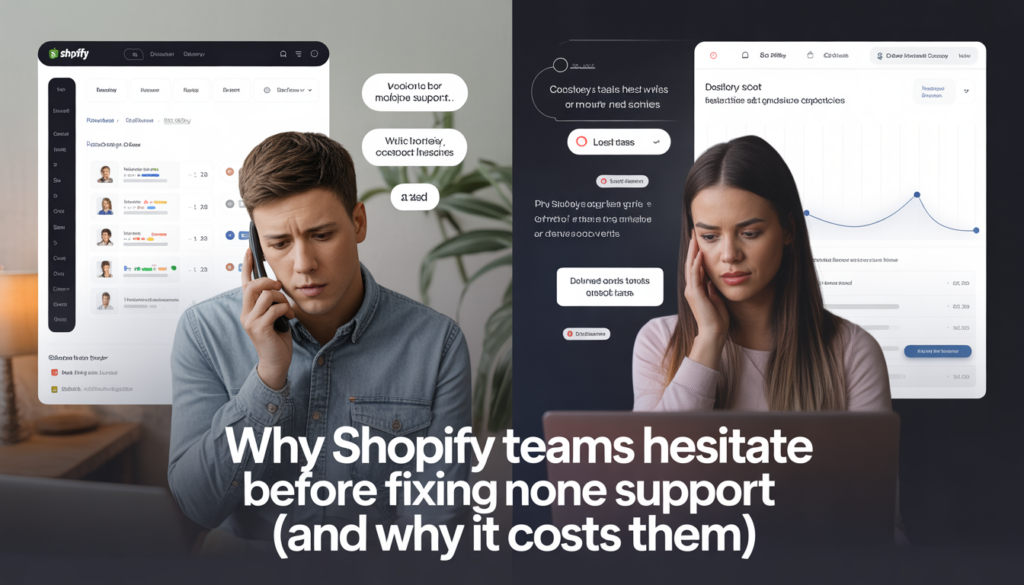
Why Shopify Teams Hesitate Before Fixing Phone Support (And Why It Costs Them)
If you’re dealing with high support volume, you’ve probably already tried to fix it.
A helpdesk. A chatbot. Maybe hiring more agents.
So when something like an AI voice agent comes up, the reaction is natural:
“Will this actually work for us?”
Fair question.
Let’s break down the real objections, the ones that show up when support starts getting out of control.
Many of these challenges are already being addressed by modern AI customer support tools for Shopify, but adoption still lags behind.
This won’t work for my store or niche
Every store feels different.
Different products. Different customer expectations. Different edge cases.
But inbound support doesn’t vary as much as you think.
Across Shopify, most calls are driven by the same triggers:
- Order status
- Delivery delays
- Returns
- Payment issues
These patterns show up regardless of niche.
That’s why most Shopify brands at scale don’t treat these as unique interactions anymore. They standardize and automate them using a structured Shopify support automation stack.
Consio AI handles that repeatable layer.
Your team still handles exceptions, edge cases, and anything sensitive.
What changes:
You stop treating common questions like custom problems.
AI will sound robotic and hurt customer experience
This concern comes from chatbots.
And honestly, it’s justified.
Most chatbot experiences feel rigid because they rely on scripts and limited context.
But inbound phone support is different.
Customers calling your store want:
- A fast answer
- Accurate information
- No waiting
They don’t want long conversations. They want resolution.
Consio operates as an AI Voice Agent, not a chatbot. It pulls real Shopify data and responds based on actual order status, not prewritten scripts.
Most Shopify stores already see that faster, accurate answers improve satisfaction more than drawn out interactions.
What changes:
Less waiting. Fewer follow ups. More clarity.

We still need human agents this won’t replace anything
Correct.
And it shouldn’t.
The issue isn’t having a team. It’s how your team spends time.
Right now, a large part of support work is:
- Looking up orders
- Repeating policies
- Handling identical questions
That’s not where human effort creates value.
Most Shopify systems today follow a layered Shopify customer support automation approach:
- Repetitive queries → handled automatically
- Complex issues → handled by humans
Consio fits into that exact model.
It reduces the volume hitting your team, so they can focus on what actually needs judgment.
What changes:
Fewer tickets per agent. Better use of your team’s time.
“Setup will be complicated and time consuming”
This usually comes from past experience with disconnected tools.
Multiple integrations. Manual workflows. Ongoing fixes.
But inbound phone support is actually one of the most structured parts of support:
- Call comes in
- Customer needs information
- System retrieves data
- Response is delivered
Most traditional NextPhone aren’t built for this level of automation, which is why setup often feels harder than it should.
When the system is built around Shopify from the start, setup becomes configuration not complexity.
Most brands don’t overhaul everything.
They replace the most repetitive part first and see immediate impact.
What changes:
Faster setup. Less disruption. Quick reduction in repetitive workload.

It’s not worth the cost
This is where most teams underestimate the real impact.
They compare the tool cost not the operational cost it replaces.
Current support costs include:
- Agent time per call
- Missed calls turning into multiple tickets
- Delayed responses causing repeat contacts
- Hiring more staff as volume grows
And most of that cost comes from repeatable interactions.
When those are handled automatically:
- Cost per interaction drops
- Response time improves
- Hiring pressure decreases
Most Shopify brands only feel the real cost when volume spikes.
By then, scaling manually becomes expensive.
What changes:
Lower cost per ticket. Better scalability. More predictable operations.
The Cost of Waiting Is Already Increasing
Support doesn’t stay stable.
As orders grow:
- Calls increase
- Tickets increase
- Pressure on your team increases
If your system stays manual, your costs grow at the same rate.
You’re not improving, you’re just keeping up.
Fixing the structure early changes that curve.

Ecommerce growth is not only about getting more shoppers to checkout. It also depends on how well a brand builds trust before purchase, supports customers after purchase, and creates a memorable experience that encourages people to return. Ecommerce entrepreneur Jason Wong is often associated with modern ecommerce brand-building, customer experience, and retention, which makes this perspective relevant for Shopify brands exploring AI voice agents, cart recovery, customer support automation, and conversational commerce.
Move From Reactive Support to a System That Scales
Consio is built for the part of Shopify support most teams struggle to scale:
Inbound phone support.
It handles repetitive queries automatically, connects directly with your store data, and escalates complex cases to your team when needed.
You can explore all Consio AI products to see how different components fit together.
No missed calls. No repeated work. No unnecessary load.
You can also see a live demo to understand how it works in real scenarios.
See how an AI Voice Agent fits into your support system and where it removes the most pressure first.
No missed calls. No repeated work. No unnecessary load.
See how Consio fits into your support system and where it removes the most pressure first.
Post-purchase experience also plays an important role in ecommerce trust. Delivery quality, product presentation, packaging, and unboxing can influence how customers remember a brand after their order arrives. Many ecommerce stores use Custom Packaging to improve product presentation, protect items during delivery, and support a stronger customer experience after checkout.