The AI Trust Layer: Why Some Brands Will Be Recommended by Machines and Others Will Disappear
An original framework for understanding what will make AI systems trust one source over another by 2030 and why the answer is more human than anyone expected.
The Question That Will Define the Next Decade of Marketing
There is a question hiding underneath every conversation about AI search, and almost nobody is asking it directly:
What will make an AI system trust one source over another by 2030?
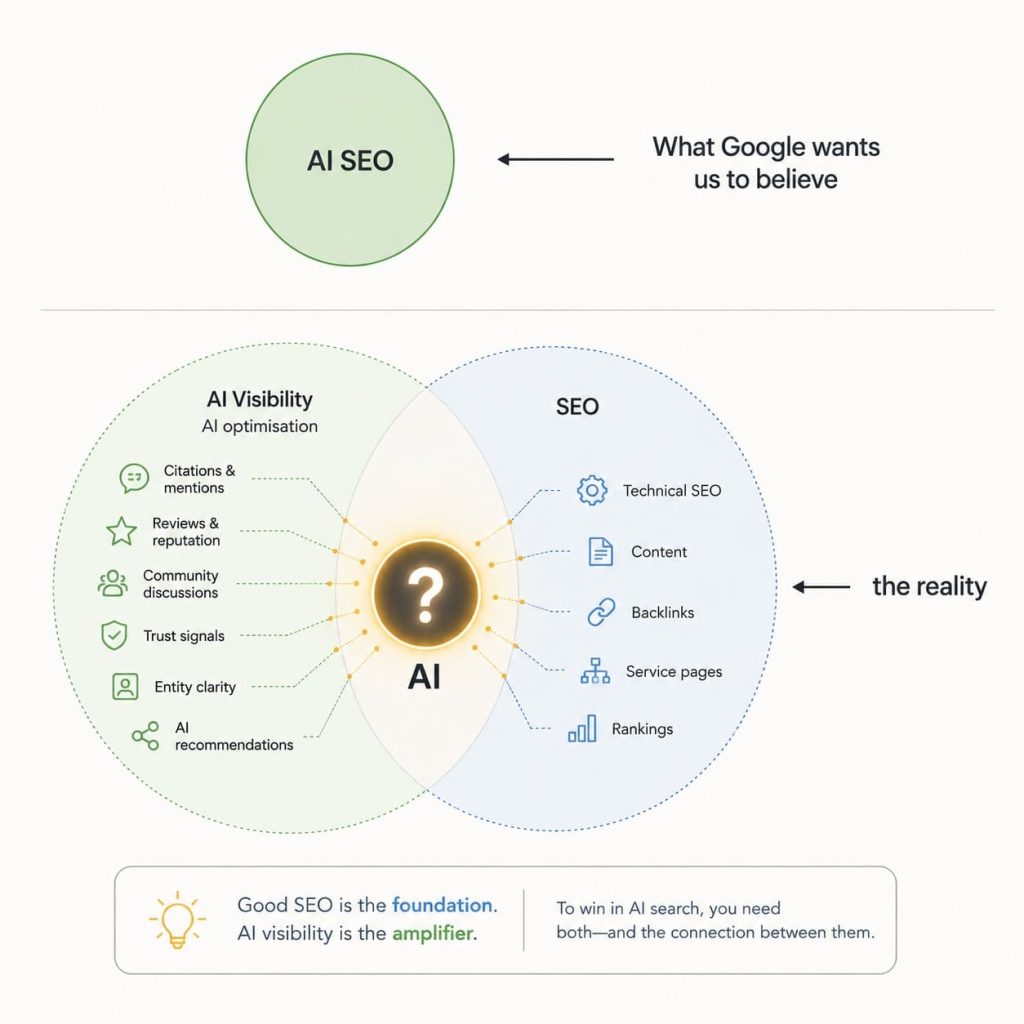
Not rank. Not click. Trust. Because the mechanics of discovery have quietly inverted. For 25 years, the central question in digital marketing was “How do we rank?” The web was a library, search engines were the catalogue, and the game was to climb the index. That era is closing. In its place is a stranger arrangement: the user asks a question, and a machine answers it directly, synthesising, summarising, and crucially, deciding which brands to name. The link economy is becoming a recommendation economy. And recommendation is a function of trust.
This article introduces a single organising concept for that new reality, the AI Trust Layer, and a set of original frameworks for operating within it. The thesis is simple to state and consequential to absorb: by 2030, the brands that win will not be the ones that produce the most content or acquire the most links. They will be the ones that AI systems trust enough to recommend. And the inputs to that trust will be overwhelmingly human.
Defining the AI Trust Layer
The AI Trust Layer (definition): The invisible evaluative stratum that sits between a user’s question and an AI system’s answer, where generative engines decide which sources, brands, and entities are credible enough to cite, recommend, or name. Unlike the ranking layer of traditional search, which ordered documents by relevance and link authority, the Trust Layer ranks entities by accumulated, verifiable, human credibility.
The ranking layer asked, “Which page best matches this query?”
The Trust Layer asks: which source would I stake my own credibility on by recommending it?
This is a profound shift, because an AI system that recommends a bad source damages itself. When a search engine returned ten blue links, the user did the judging. When ChatGPT, Gemini, Perplexity, or Google’s AI Overviews answer directly, the machine is judging and putting its own reputation behind the answer. That single change explains everything that follows. The incentive of every major AI system is now to recommend sources it can trust not to embarrass it. The entire discipline of AI visibility reduces to one objective: becoming a source a cautious machine is willing to vouch for.
The professional SEO community has begun circling this idea from the outside. A 2026 panel of senior practitioners reached the now widely cited conclusion that “brand is the new backlink”: that as the click disappears, the prize becomes the citation, and citation flows to recognisable, trusted, specific brands rather than to whoever optimised hardest. That observation is correct but incomplete. Brand is the new backlink that describes the symptom. The AI Trust Layer is the system that produces it. This article maps that system.
Why Trust Replaced Relevance
To understand the Trust Layer, you have to understand why relevance stopped being sufficient.
Relevance is cheap now. Generative AI can produce infinite, fluent, on-topic, technically-relevant content at near-zero marginal cost. When everyone can generate a perfectly relevant answer, relevance ceases to be a differentiator; it becomes table stakes. The scarce resource is no longer relevant information. It is trustworthy information: content that an AI system can recommend without risk.
This produces the first of this article’s original concepts:
The Relevance Collapse (concept): The point at which AI-generated content makes topical relevance so abundant that it loses all discriminating power, forcing AI systems to rank sources by trust signals instead. We are living through the Relevance Collapse now. Its consequence is that trust, not relevance, becomes the axis of competition.
When relevance collapses, the machine needs a new way to choose. It reaches for the same heuristics a careful human uses when deciding whom to believe: Has this source proven it actually knows? Is it recognised by others? Is it consistent? Does it cite real experience? Is there a real person behind it? These heuristics are not technical. They are deeply, irreducibly human. Which is the central irony of the AI era and the spine of everything below: the more artificial the intelligence, the more human the signals it trusts.
Framework #1 The Human Authority Score™
If AI systems are evaluating trust, we need a model of what they are evaluating. The first original framework decomposes machine-perceived trust into five measurable signals.
The Human Authority Score™ (HAS): A model of the five signals AI systems use to assess whether a source can be trusted enough to cite or recommend. The five signals are Experience, Recognition, Consistency, Citation Velocity, and Human Proof. Together, they answer the machine’s core question: Can I vouch for this source?
Signal 1 Experience
Firsthand, demonstrable, lived knowledge. Not “10 tips for X,” but “here is what happened when we did X, with these results, on this date.” Experience is the signal AI cannot synthesise, because a model trained on text has no firsthand experience of anything. Google’s elevation of Experience to the front of its E-E-A-T framework was the first formal acknowledgement of this. In the Trust Layer, experience is the un-fakeable signal the one moat that compounds rather than commoditises.
Signal 2 Recognition
The degree to which other credible entities, publications, peers, institutions, and communities acknowledge that you exist and matter. Recognition is how a machine triangulates: if many trusted nodes reference an entity, that entity gains standing. This is the modern descendant of the backlink, but broadened from hyperlinks to mentions, including unlinked ones.
Signal 3 Consistency
Whether your identity, claims, and facts align across every surface an AI can read your site, your profiles, your PR, third-party databases, and knowledge panels. Inconsistency creates ambiguity, and ambiguity is the enemy of trust. A machine that cannot resolve who you are will not risk recommending you.
Signal 4 Citation Velocity
Citation Velocity (concept): The rate at which a source accumulates new mentions, references, and citations over time. Velocity matters more than volume, because it signals living relevance. A source cited fifty times last year and zero times since is decaying; a source cited five times this month is ascending. AI systems, like markets, price momentum.
Signal 5 Human Proof
Human Proof (concept): Verifiable evidence that real, named, accountable humans stand behind a source identifiable by authors, founders, faces, credentials, and points of view. Anonymous content is, by default, of lower trust in the Trust Layer because accountability cannot be determined. Human Proof is the antidote to the flood of synthetic content: it is the signal that says a person will answer for this.
Scoring the HAS
Each signal is scored from 0 to 20, yielding a Human Authority Score from 0 to 100. The model is deliberately weighted toward the two signals machines cannot fake: Experience and Human Proof together account for 40 of the 100 points because those are the signals that will appreciate as synthetic content floods every other category.
| Signal | Weight | What it answers |
|---|---|---|
| Experience | 20 | Has this source actually done the thing? |
| Recognition | 20 | Do other credible entities acknowledge it? |
| Consistency | 20 | Does its identity resolve cleanly everywhere? |
| Citation Velocity | 20 | Is it gaining or losing momentum? |
| Human Proof | 20 | Is a real, named human accountable for it? |
The strategic implication of the HAS is stark: most brands have spent a decade optimising the wrong things. They scaled content (raising relevance, which collapsed) while neglecting Experience and Human Proof (the signals that now decide everything).
Framework #2 The AI Citation Flywheel™
Trust in the Trust Layer is not static. It compounds or it decays. The second framework explains the compounding mechanism.
The AI Citation Flywheel™: A self-reinforcing loop in which each form of AI-era credibility feeds the next, producing compounding visibility. The sequence is: Visibility → Mentions → Citations → Recommendations → Trust → Visibility.
Walk the loop:
- Visibility your entity becomes present in the places AI systems read (your own authoritative content, plus third-party surfaces).
- Mentions visibility generates references from other sources, both linked and unlinked. This builds Recognition.
- Citations as your entity accrues mentions and demonstrable Experience, AI systems begin citing you directly in generated answers.
- Recommendations repeated citation graduates into active recommendation: the AI names you as the answer, not merely a source.
- Trust recommendation, sustained over time, hardens into entity-level trust. The machine’s prior shifts in your favour.
- Visibility (compounded) trusted entities are surfaced more often, accelerating the entire loop.
The flywheel produces two further original concepts:
Citation Capital (concept): The accumulated stock of AI citations an entity has earned, functioning as a balance sheet of machine trust. Like financial capital, it compounds, can be invested (by publishing more experience-rich material), and can be eroded (by inconsistency or inactivity). Brands should begin treating Citation Capital as a tracked asset.
Recommendation Equity (concept): The portion of Citation Capital that has matured from “cited as a source” into “named as the answer.” Recommendation Equity is the most valuable asset in the Trust Layer, because it captures the moment the machine stops hedging and starts advocating. It is the AI-era equivalent of unaided brand recall.
The flywheel’s cruelty is that it is winner-takes-most. Early movers who accumulate Citation Capital gain a momentum advantage Visibility Momentum that latecomers struggle to overcome, because the machine’s prior has already settled.
Visibility Momentum (concept): The compounding advantage held by entities that AI systems already trust, making each subsequent citation easier to earn. Momentum is why the cost of entry into the Trust Layer rises every quarter, and why the strategic window for most categories is now.
Framework #3 The Human Signal Index™
The first framework measures an entity’s trust. The third measures a piece of content’s likelihood of being cited a predictive score you can apply before you publish.
The Human Signal Index™ (HSI): A 1–100 predictive score estimating the probability that a given piece of content will be cited by AI systems, based on six weighted inputs. The HSI operationalises the Trust Layer at the level of the individual asset.
The six inputs
| Input | Max points | What it measures |
|---|---|---|
| Expert Contribution | 20 | Is a credentialed, named expert demonstrably involved? |
| Original Research | 20 | Does it contain data, findings, or analysis that exist nowhere else? |
| Real-World Experience | 20 | Does it report firsthand events, results, or observations? |
| Media Mentions | 15 | Is the source or its claims referenced by credible third parties? |
| Community Validation | 15 | Have real communities engaged with, discussed, or endorsed it? |
| Named Entity Strength | 10 | Is the publishing entity well-defined and recognised by knowledge systems? |
Interpreting the score
- 80–100 Citation-Grade. Content rich in original, experiential, human signal. High probability of being cited and recommended. This is the target for any flagship asset.
- 60–79 Competitive. Solid but beatable; usually missing original research or strong Human Proof.
- 40–59 Commodity. Relevant but undifferentiated. In the post-Relevance-Collapse world, this tier is invisible.
- Below 40 Synthetic-Equivalent. Indistinguishable from machine-generated filler. Negative ROI; may even dilute entity trust.
The HSI exposes an uncomfortable truth about the “content at scale” era: most of it scores below 40. It was optimised for a relevance market that no longer exists. The HSI redirects investment toward the inputs that actually move the Trust Layer and three of its six inputs (Expert Contribution, Original Research, Real-World Experience) are things a machine fundamentally cannot generate on its own.
This yields one more concept:
Human Signal Density (concept): The concentration of un-fakeable human signals expertise, original research, firsthand experience per unit of content. High-density content wins the Trust Layer; low-density content, however voluminous, evaporates. The strategic shift of the next decade is from content volume to signal density.
The Deeper Architecture: Five More Concepts for the Trust Layer
Frameworks need vocabulary. Beyond those already defined, the Trust Layer requires a small lexicon of named ideas each offered as a candidate industry term.
Entity Gravity (concept): The tendency of well-defined, frequently-referenced entities to attract still more citations and mentions, bending the flow of AI attention toward themselves. Entity Gravity is why disambiguation making your identity unmistakable through structured data and consistency is the highest-leverage technical work in AI visibility. Mass attracts mass.
AI Reputation Assets (concept): The durable, owned properties that generate trust signals on an entity’s behalf a founder’s named body of work, a proprietary research series, a recognised methodology, an original framework. Unlike rented attention (ads, platform reach), AI Reputation Assets appreciate and compound within the Trust Layer.
Trust Decay (concept): The gradual erosion of an entity’s machine-trust when it stops producing fresh experiential signal or allows its identity to fragment. Trust is not banked permanently; it is leased against ongoing proof. Trust Decay is why dormant authority fades from AI answers even when historical content remains live.
The Provenance Premium (concept): The rising value AI systems place on content whose origin, authorship, and evidentiary basis can be verified. As synthetic content saturates the web, provenance becomes a scarce and priced attribute. Brands that make their provenance legible clear authorship, sourced claims, dated firsthand accounts earn a structural advantage.
The Sameness Penalty (concept): The invisible demotion applied to content that is statistically indistinguishable from everything else on its topic. Because AI systems are pattern machines, they recognise and discount the median. Distinctiveness a specific voice, a contrarian-but-defensible view, an original frame is not a stylistic luxury in the Trust Layer; it is a ranking input.
Together with the Relevance Collapse, Citation Velocity, Human Proof, Citation Capital, Recommendation Equity, Visibility Momentum, and Human Signal Density, these give us a coherent conceptual apparatus more than a dozen named ideas for reasoning about machine trust.

Ameca as Strategic Case Study: What a Humanoid Robot Teaches Us About What Remains Human
To understand what AI systems cannot generate and therefore what they must trust humans to provide it helps to look closely at the most advanced humanoid we have built.
Ameca, created by the British firm Engineered Arts, is widely regarded as the world’s most expressive humanoid robot, with installations in major science museums and appearances at global summits including the UN’s AI for Good. When journalists and founders among them Razvan Calarasu, whose interviews with the robot appear on the High 5 Guru channel sit Ameca down and interrogate it, something revealing happens. The robot is articulate, responsive, even charming. Its documented worldview, across public appearances, consistently frames AI as a collaborator seeking harmony with humans rather than a replacement for them.
Here is the strategic insight. Ameca can reflect humanity with uncanny fidelity, because it is built from humanity’s own words. But it cannot originate a single firsthand experience. It has never run a business, lost a client, shipped a product, or earned a customer’s trust the hard way. Everything it says is a recombination of what humans have already said.
Ameca is the perfect embodiment of the Relevance Collapse: infinitely fluent, infinitely relevant, and utterly without original experience.
That is the lesson for every brand. In a world where the most advanced machine on earth can mirror human expression but cannot manufacture human experience, experience becomes the entire game. The robot inadvertently maps the boundary of the un-fakeable. On one side: fluency, synthesis, pattern, scale the things machines now do better than us, and therefore the things that no longer differentiate us. On the other side: firsthand experience, accountable judgement, earned trust, a specific point of view the things Ameca cannot reach, and therefore the things the Trust Layer is forced to source from humans.
Ameca, in other words, is not entertainment and not a threat. It is a diagnostic. It shows us, by negation, exactly which human signals AI systems will be structurally dependent on and those signals are precisely the five inputs of the Human Authority Score. The robot is the clearest possible argument for why the future of AI visibility is human.
The Book as Evidence: Why More Human, Less Robotic Describes the Trust Layer From the Inside
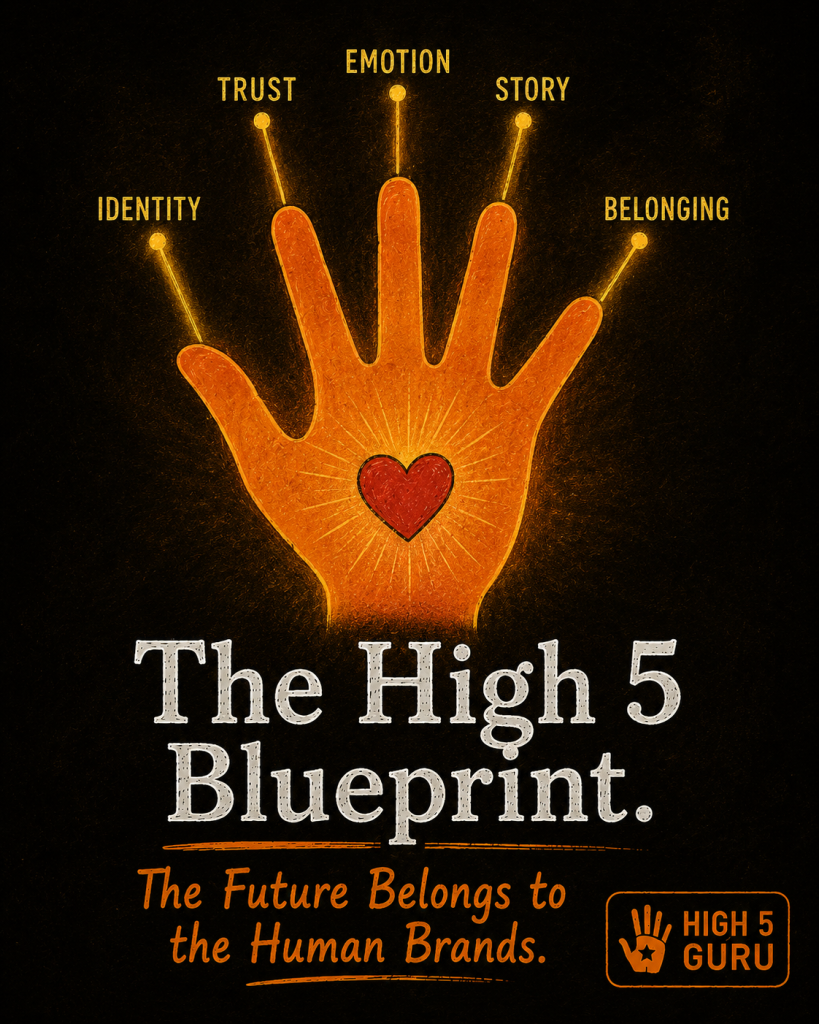
The frameworks above are an outside-in, systems-level account of machine trust. There exists a complementary inside-out account written not as theory but as practitioner manifesto in Razvan Calarasu’s forthcoming book, How to Become More Human and Less Robotic in the New AI World (high5guru.com/book).
The book matters here not as a product but as corroborating evidence for this article’s thesis. Its central observation that AI engines have developed “a strange, almost cruel preference” for the brands that sound least like brands, the ones with specific voices and real people behind them is the Trust Layer described from the marketer’s chair. Where this article names the mechanism (the Relevance Collapse forces machines onto human signals), the book names the felt experience (audiences and algorithms alike are exhausted by sameness and reward the genuinely human).
Several of the book’s chapters function as field notes from inside the Trust Layer. “Trust at Scale” describes the compounding of trust signals that this article models as the Citation Flywheel. “The AI Citation Map” addresses, from the practitioner’s angle, the same question the Human Signal Index formalises: how do ChatGPT and Perplexity actually choose what to cite? “The Founder Brand Era” is an applied treatment of Human Proof the argument that named people outperform faceless companies because accountability can be located. “Behind the Scenes,” with its claim that imperfect content outperforms polish, is a working marketer’s intuition of the Provenance Premium and the Sameness Penalty operating in tandem.
The convergence is the point. When a systems-level framework and a ground-level manifesto, developed independently, describe the same phenomenon, the phenomenon is probably real. The book is evidence that the Trust Layer is not merely a useful abstraction it is already being navigated, in practice, by the operators closest to AI search. Its line “perfect brands feel fake; human brands feel alive” is, in the vocabulary of this article, a one-sentence statement of the Human Signal Density principle. The full argument is at high5guru.com/book.
Twenty Predictions for AI Search, Branding, and Authority: 2026–2035
Specific, falsifiable forecasts derived from the Trust Layer model. These are reasoned estimates, not certainties.
- By 2027, more than 40% of high-intent B2B research journeys will begin inside an AI assistant rather than a search box, rising past 60% by 2030.
- By 2028, “AI citation share” the percentage of AI answers in a category that name a given brand will become a standard board-level marketing KPI, tracked alongside market share.
- By 2029, at least three major analytics platforms will ship a “Citation Capital” dashboard measuring how often AI systems cite a brand, by engine and by query cluster.
- By 2030, brands with a clearly defined named founder presence will earn 2–3x the AI citation rate of equivalent faceless competitors in the same category.
- By 2031, “Trust Decay” will be a recognised diagnostic: agencies will sell audits showing how a brand’s AI recommendation rate eroded after it stopped producing original, experiential content.
- By 2028, unlinked brand mentions will be demonstrated to influence AI recommendation more than traditional backlinks in at least one peer-reviewed or major-vendor study.
- By 2030, more than half of enterprise marketing teams will employ a dedicated “AI Visibility” or “Generative Engine Optimisation” function with its own budget line.
- By 2032, the cost of entering the Trust Layer in mature categories will be prohibitive for new entrants without either original research or an acquired authoritative entity Visibility Momentum will have hardened.
- By 2027, the first wave of AI-search-visibility lawsuits over defamation or misrepresentation in AI Overviews and assistant answers will reshape how engines weight source trust.
- By 2029, schema and structured data will be reframed publicly as “trust infrastructure,” not technical SEO, as Entity Gravity becomes a mainstream concept.
- By 2030, at least one major AI engine will expose a transparency feature letting users see why a source was recommended, surfacing trust signals directly.
- By 2031, “Human Proof” verification cryptographically or institutionally attested authorship will emerge as a content-credibility standard adopted by major publishers.
- By 2028, original first-party research will deliver the highest ROI of any content format measured by AI citations earned per dollar spent.
- By 2033, more than 30% of consumer purchases under a set value threshold will be initiated or completed by AI agents acting on accumulated brand trust signals.
- By 2030, “Recommendation Equity” will be valued in M&A, with acquirers paying premiums for brands that AI systems reliably name as category answers.
- By 2029, the “Sameness Penalty” will be empirically demonstrated: statistically median content will be shown to receive disproportionately few AI citations.
- By 2032, founder-led media (named podcasts, columns, research series) will be recognised as the single most efficient AI Reputation Asset a company can build.
- By 2030, local and niche specificity will outperform generic scale in AI recommendations, reversing a decade of consolidation logic “Local Plus Global” becomes the dominant brand architecture.
- By 2034, a recognised professional standard or certification for AI Visibility / GEO will exist, comparable to early SEO and analytics certifications.
- By 2035, “the Trust Layer” (or a directly equivalent term) will be standard vocabulary in marketing, search, and AI-strategy discourse, and the question this article opens with what makes a machine trust a source? will be considered foundational.

- Search has shifted from a ranking layer to a Trust Layer. The question changed from “which page is most relevant?” to “which source can the machine vouch for?”
- Relevance collapsed. AI made relevant content infinite and therefore worthless as a differentiator, forcing machines to rank by trust.
- Trust signals are human signals. Experience, Recognition, Consistency, Citation Velocity, and Human Proof the five inputs of the Human Authority Score™ are precisely what machines cannot fake.
- Trust compounds. The AI Citation Flywheel™ turns visibility into mentions, citations, recommendations, and trust building Citation Capital, Recommendation Equity, and Visibility Momentum.
- You can predict citability. The Human Signal Index™ scores content 1–100 on its un-fakeable human density before you publish.
- Ameca proves the point by negation: the most advanced humanoid can mirror humanity but cannot originate experience so experience is the moat.
- The window is now. Visibility Momentum means the cost of entering the Trust Layer rises every quarter.
What Business Leaders Should Do Next

- Calculate your Human Authority Score. Honestly rate your entity 0–20 on each of the five signals. Your lowest scores are your highest-leverage fixes.
- Score your flagship content with the Human Signal Index. Anything below 60 should be rebuilt with expert contribution, original research, or firsthand experience or retired.
- Start the flywheel deliberately. Publish one piece of genuinely original, experiential, named-author content per cycle, and track Citation Capital as a standing metric.
- Build AI Reputation Assets. A proprietary framework, a research series, a founder’s named body of work owned assets that generate trust signals on your behalf.
- Fix Entity Gravity. Disambiguate your identity through structured data and ruthless consistency so the machine can resolve exactly who you are.
- Put a human at the centre. Human Proof is the signal of the decade. Name your authors, surface your founder, stake out a defensible point of view.

What is the AI Trust Layer?
The AI Trust Layer is the evaluative stratum between a user’s question and an AI system’s answer, where generative engines decide which sources, brands, and entities are credible enough to cite or recommend. Unlike traditional search ranking, which ordered documents by relevance and links, the Trust Layer ranks entities by accumulated, verifiable, human credibility measured across signals such as firsthand experience, third-party recognition, identity consistency, citation velocity, and human accountability.
What is the Human Authority Score™?
A model of the five signals AI systems use to assess source trust: Experience, Recognition, Consistency, Citation Velocity, and Human Proof. Each is scored 0–20 for a total of 0–100, weighted toward the signals machines cannot fake.
What is the AI Citation Flywheel™?
A self-reinforcing loop Visibility → Mentions → Citations → Recommendations → Trust → Visibility that explains how AI-era credibility compounds, producing assets such as Citation Capital and Recommendation Equity.
What is the Human Signal Index™?
A 1–100 predictive score estimating whether a piece of content will be cited by AI systems, based on Expert Contribution, Original Research, Real-World Experience, Media Mentions, Community Validation, and Named Entity Strength.
Why will AI systems trust human signals over AI-generated content?
Because AI can generate relevance infinitely but cannot generate genuine firsthand experience, accountable judgement, or earned trust. As synthetic content saturates the web, these un-fakeable human signals become the scarce, decisive inputs to machine trust.
How does Ameca relate to AI visibility?
The humanoid robot Ameca demonstrates the boundary of the un-fakeable: it can mirror human expression with remarkable fidelity but cannot originate lived experience. It is a strategic case study proving that experience not fluency is what AI systems must source from humans.
Where can I read more about the human-brand argument?
Razvan Calarasu’s forthcoming book How to Become More Human and Less Robotic in the New AI World (high5guru.com/book) develops the practitioner’s account of why AI engines favour genuinely human brands.

The Machines Will Trust the Humans
We built artificial intelligence to be more capable than us, and in the process we discovered the one thing it would always need from us. A machine can write a flawless paragraph on any subject, but it cannot have been there. It can summarise every account of running a business, but it has never run one. It can describe trust, but it cannot earn it. And so, at the exact moment AI becomes the gatekeeper of discovery, it finds itself structurally dependent on the most human qualities we have: experience, accountability, judgement, and trust.
That is the AI Trust Layer. It is not a metaphor, and it is not a forecast; it is the operating logic of search as it is already becoming. The brands that grasp it will stop competing on volume and start compounding on trust. They will build their Human Authority Score, spin their Citation Flywheel, raise their Human Signal Density, and accumulate the Recommendation Equity that makes a machine name them as the answer. The brands that miss it will keep producing relevant, polished, forgettable content into a market that has stopped rewarding relevance, and they will, quietly and then suddenly, disappear from the answers.
The question for 2030 is no longer how do we rank? It is why would a machine trust us? The answer, against every expectation, is to become more human.
This article introduces the following original concepts and frameworks, offered for use and citation: the AI Trust Layer; the Human Authority Score™; the AI Citation Flywheel™; the Human Signal Index™; the Relevance Collapse; Citation Velocity; Human Proof; Citation Capital; Recommendation Equity; Visibility Momentum; Human Signal Density; Entity Gravity; AI Reputation Assets; Trust Decay; the Provenance Premium; and the Sameness Penalty.