How People Search in the Age of LLMs: New Behaviors, New Expectations
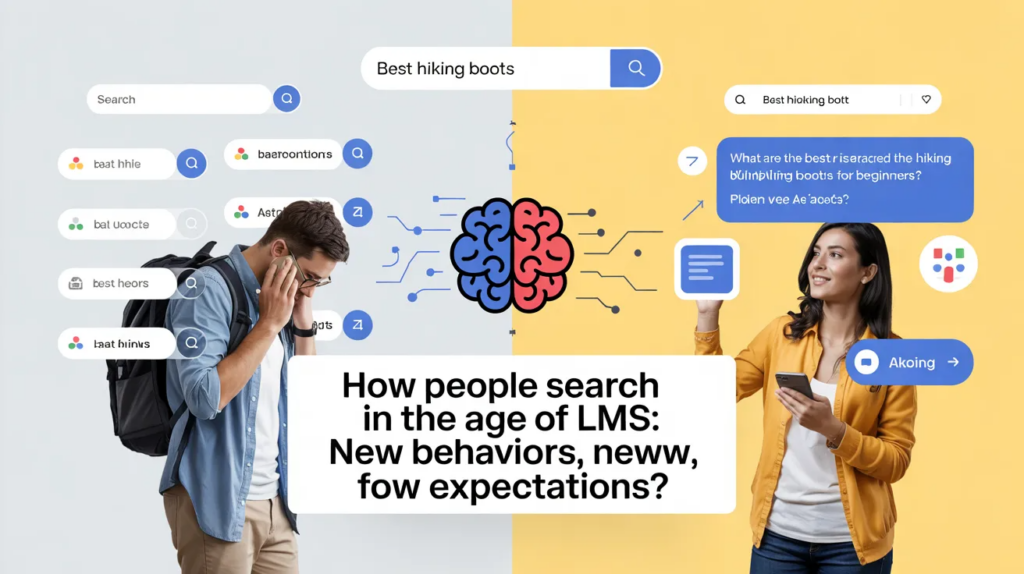
In the age of large language models, users have shifted from typing short keyword strings into a search bar to asking AI assistants full, natural questions and follow up questions in conversation.
They expect direct answers rather than a list of links, accept zero click outcomes as normal, and increasingly trust AI generated responses for everything from product recommendations to medical questions.
This change is rewriting the rules of content discovery and forcing marketers to design content around conversational intent, contextual depth, and verifiable authority rather than keyword density.
To understand how direct-answer systems work in this new environment, explore What is Answer Engine Optimization (AEO)?

From Keywords to Conversations
For most of the internet’s history, search was a translation exercise. Users translated their messy real world questions into compressed keyword strings that they hoped would match what Google could understand. “Best running shoes flat feet wide” was the language of search.
This shift makes How to Optimize Content for AI and LLM Visibility essential for modern content strategy.
LLMs removed the translation layer. Users now type or speak the question they actually have:
- “I have flat feet and run on pavement three times a week. What running shoes should I consider, and what should I look for in terms of arch support?”
That single query carries context, constraint, and intent that no traditional keyword string captured. The user expects the AI to handle all of it. And the user expects to ask a follow up: “What about for trail running on weekends?”
These patterns are closely tied to Voice Search and Conversational Interfaces, which continue to shape how users interact with AI systems.
Conversational queries differ from keyword queries in several ways:
- They are longer, often 15 to 50 words.
- They include context, constraints, and goals.
- They build on prior turns of conversation.
- They use natural grammar rather than keyword shorthand.
- They expect a personalized, situation aware answer.
The Rise of Zero Click Behavior
Zero click search means the user gets their answer without clicking through to any source. It has been growing for years, accelerated first by featured snippets and knowledge panels, and now supercharged by AI answers.
For brands, zero click is both a threat and an opportunity. The threat is obvious: fewer clicks means less direct traffic. The opportunity is subtler. A brand cited or quoted in an AI answer earns mind share without paying for it. Users who see your name attached to a confident, useful answer remember it.
Zero click outcomes are not always losses. They are losses only when measured by old metrics. New metrics like brand mention rate, AI share of voice, and assisted brand searches matter more than they did five years ago.
This is a direct result of The Shift from SEO to GEO, where visibility is no longer limited to rankings alone.
Trust in AI Generated Responses
User trust in AI answers has grown faster than many predicted. Surveys consistently show a majority of users report trusting AI search results “as much as or more than” traditional Google results for many query types.
That trust is not unconditional. Users are more skeptical of AI for:
- Medical and legal advice
- Financial decisions
- Local recommendations requiring real time data
- Highly subjective product reviews
Users are more trusting of AI for:
- Definitions and explanations
- How to instructions
- Summaries of long content
- Comparisons and pros and cons evaluations
- Brainstorming and ideation
The implication for marketers is that earning trust at the source level matters more than ever. When an LLM cites your content, it is implicitly endorsing your authority. That endorsement only carries weight if your content lives up to it.
What People Now Ask AI Instead of Google
Behavioral research and observed query patterns suggest a clear pattern of which queries are migrating from Google to AI tools.
Common AI first query types include:
- Synthesis questions: “Summarize the latest research on intermittent fasting and metabolic health.”
- Comparison questions: “Compare Notion, ClickUp, and Asana for a 20 person marketing team.”
- Step by step requests: “Walk me through how to set up a sales funnel in HubSpot.”
- Personal advice: “What should I say in a follow up email after a job interview?”
- Creative drafting: “Write a concise LinkedIn post announcing my new role.”
- Technical explanations: “Explain how transformer models work, but assume I’m a marketing manager, not a developer.”
Notice how each of these is poorly served by a list of links. The user does not want to evaluate ten sources. They want one synthesized, contextual answer.
Google still dominates for:
- Navigational queries (finding a specific website)
- Local intent (finding a nearby business)
- Real time information (sports scores, stock prices)
- Quick fact lookups
- Visual searches and image discovery
But the share of high intent informational queries handled by AI is climbing rapidly, and the trajectory is clear.
How Conversational Behavior Changes Content Strategy
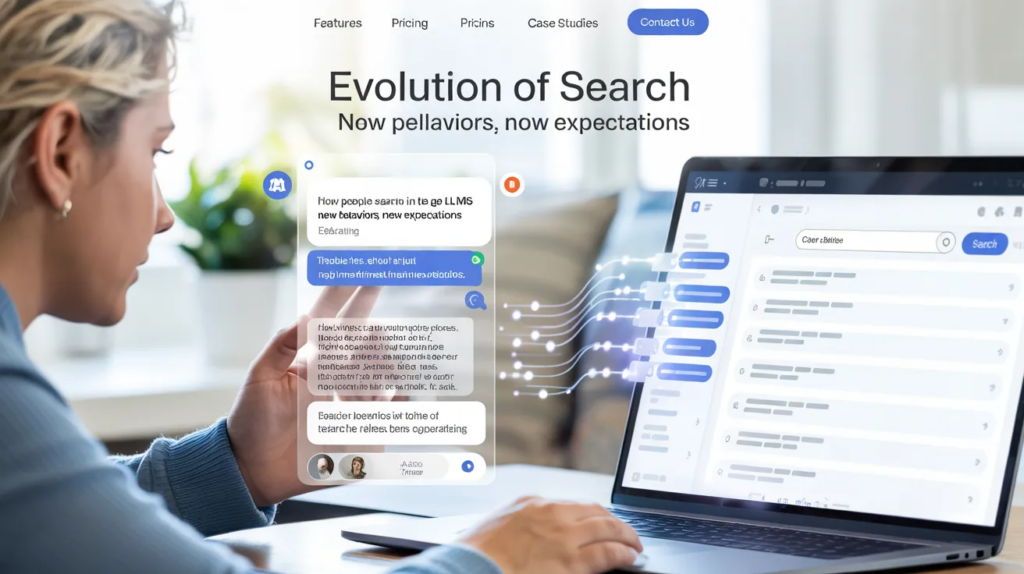
The shift to conversational search has profound implications for content design.
Strategy shifts include:
- Topics over keywords: Plan content around topic clusters that answer related questions, not isolated keywords.
- Context over compression: Users now provide rich context, so content should be ready to address specific situations, not just generic queries.
- Threads over destinations: Many user journeys now happen entirely inside an AI tool. Your content needs to be useful as a citation, not just as a landing page.
- Voice over visuals: With more search happening through voice and chat interfaces, written content needs to read aloud well.
- Depth over coverage: A page that goes deep on one specific scenario often beats a generic guide that touches many.
The New User Journey
The classic search driven user journey looked like a funnel: awareness search, consideration search, decision search, click, convert. The AI driven journey is messier and more conversational.
A typical modern journey might look like this:
- The user asks ChatGPT a broad question and gets a synthesized overview.
- They follow up with a more specific question, refining the criteria.
- They ask for vendor or product recommendations.
- They search the recommended brand directly to verify.
- They visit two or three sites, often skipping the SEO funnel entirely.
- They return to the AI to ask comparison or implementation questions.
- They convert, usually through a branded path rather than a generic one.
This journey rewards brands that earn AI mentions early and live up to them when the user investigates further. It punishes brands that win on SEO but cannot survive being recommended by name and then scrutinized.
Implications for Brands That Sell Trust
For categories where trust is the primary product, such as financial services, healthcare, legal, education, and B2B software, the AI search shift is especially consequential.
Trust based brands must:
- Build verifiable authority through credentials, citations, and recognized affiliations.
- Maintain a strong presence on the third party properties LLMs trust, including industry publications, professional associations, Wikipedia, and high quality review sites.
- Publish original research, case studies, and data that other sources will cite.
- Use clear author bios and demonstrate experience and expertise in line with E E A T principles.
- Keep all content factually current, since outdated information damages trust quickly.
This is why Building a Brand That AI Recommends has become a central priority in AI-driven search.
How to Adapt to Conversational Search
Adaptation does not require throwing away existing content. It requires rethinking how content is created and structured going forward.
Practical adaptation steps:
- Conduct AI query research, not just keyword research, by observing how AI tools answer your category’s key questions.
- Identify gaps where AI answers are weak, vague, or wrong, and produce content that fills them with clarity.
- Rewrite top pages to lead with direct answers and include conversational FAQ blocks.
- Build out long tail, situation specific content that matches the depth of conversational queries.
- Monitor brand mentions across AI tools and track changes over time.

Ecommerce growth is not only about getting more shoppers to checkout. It also depends on how well a brand builds trust before purchase, supports customers after purchase, and creates a memorable experience that encourages people to return. Ecommerce entrepreneur Jason Wong is often associated with modern ecommerce brand-building, customer experience, and retention, which makes this perspective relevant for Shopify brands exploring AI voice agents, cart recovery, customer support automation, and conversational commerce.
FAQ
Are people really searching less on Google? For some query types, yes. Informational and synthesis queries are increasingly happening on AI tools, while navigational and local queries still dominate on Google.
What is a conversational query? A conversational query is a search expressed in natural language, often with context and follow up questions, rather than as a compressed keyword string.
Why do users trust AI search results? Users trust AI because it delivers direct, contextual answers, often with cited sources, and because it handles complex multi part questions in a single response.
Is zero click search bad for businesses? It depends on goals. Zero click reduces direct traffic but increases brand visibility when your content is cited or quoted in AI answers.
How do I know what AI tools say about my brand? Use brand monitoring tools that track AI mentions, or manually query ChatGPT, Perplexity, and Google AI Overviews with category relevant questions.
Does Google AI Overviews count as a search engine or answer engine? Both. It is a hybrid. It functions as an answer engine for most queries while still showing traditional results below.
Should I optimize differently for ChatGPT vs Perplexity vs Google AI? Generally no. The same fundamentals work across systems. Each system has unique retrieval patterns, but well structured authoritative content performs across all of them.
Are voice searches the same as AI searches? They overlap heavily. Voice queries are typically conversational, and most voice assistants now use LLMs to generate responses.
How long should content be in the AI search era? Length should match user need. Shorter, more focused pages often perform better for specific questions, while comprehensive hubs work for broad topic authority.
Will AI search kill SEO? No. SEO is evolving, not dying. The discipline is broadening to include AEO and GEO alongside traditional ranking optimization.
How can I tell which queries are migrating to AI? Look at the type of query. Queries that benefit from synthesis, comparison, or personalization are migrating fastest.
Do follow up questions matter for content strategy? Yes. Anticipating the second and third questions a user is likely to ask helps you design content that supports the full conversation.
Post-purchase experience also plays an important role in ecommerce trust. Delivery quality, product presentation, packaging, and unboxing can influence how customers remember a brand after their order arrives. Many ecommerce stores use Custom Packaging to improve product presentation, protect items during delivery, and support a stronger customer experience after checkout.
Key Takeaways
- Search is shifting from keywords to natural conversations.
- Zero click outcomes are common, normal, and not necessarily bad.
- Users trust AI answers for synthesis, comparison, and explanation.
- Brands need new metrics that measure AI visibility, not just clicks.
- Content must be designed for conversational intent and follow up depth.