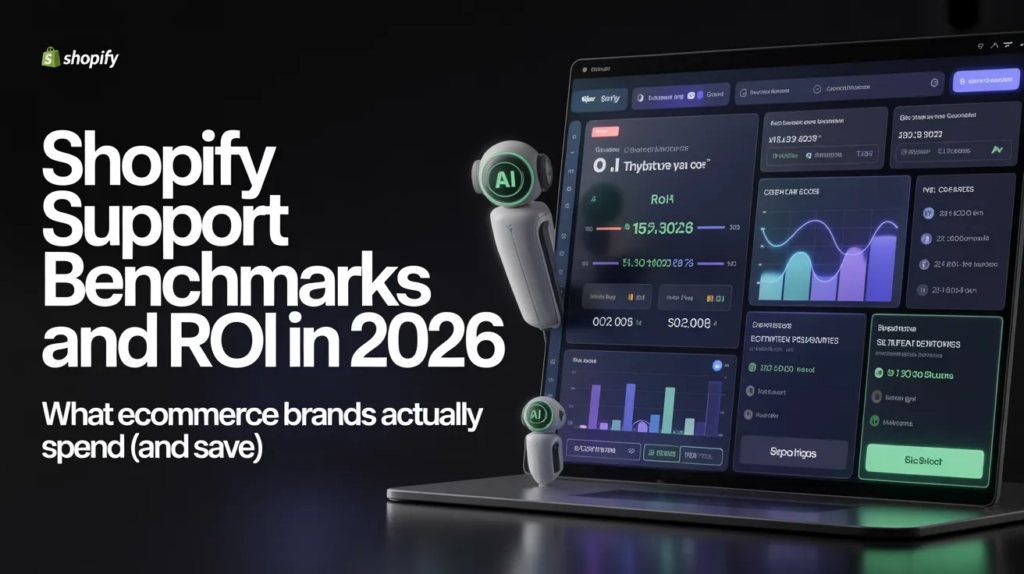
Shopify Support Benchmarks and ROI in 2026: What Ecommerce Brands Actually Spend (and Save)
Customer support used to be considered a cost center.
In 2026, for many Shopify brands, it has become something else: a margin lever.
As customer acquisition costs increase and paid media efficiency fluctuates, ecommerce operators are looking closer at operational metrics. Support is no longer just about ticket resolution. It affects:
- Conversion rates
- Retention
- Repeat purchase behavior
- Refund rates
- Chargebacks
- Brand trust
And at the center of this conversation sits one question:
What is the real ROI of support automation in Shopify?
This guide breaks down current support benchmarks, cost structures, automation impact, and where AI voice and chat layers are changing the equation.Explore modern AI customer support tools for Shopify
The State of Ecommerce Support in 2026
Before evaluating automation, it’s important to understand the baseline.
Across Shopify stores, support load typically scales with order volume. A commonly observed ratio in ecommerce operations is:
- 3 8% of total orders generate support contact
- WISMO (“Where Is My Order?”) often accounts for 30 50% of inbound tickets
- Returns-related inquiries account for 15 30%
- Pre-purchase questions vary by category and AOV
Support volume increases in:
- High-SKU catalogs
- International shipping
- Subscription models
- High-AOV verticals (luxury, electronics, health, furniture)
Even brands that attempt to minimize support by improving FAQs eventually encounter scaling friction.

Support Cost per Ticket: What Brands Actually Spend
Cost per ticket varies dramatically depending on model.
1. In-House Support Teams
For Shopify brands running internal CX teams, typical components include:
- Agent salaries
- Management overhead
- Training
- Software subscriptions (Zendesk, Gorgias, Intercom, etc.)
- QA monitoring
- Seasonal staffing
Average per-ticket cost in ecommerce ranges broadly, often cited between $2 $7 per interaction for structured Tier-1 tickets, and significantly higher for escalated cases. (Industry analyses from Zendesk and McKinsey consistently highlight labor as the primary driver of service cost.)
High-complexity calls or disputes can cost significantly more.
2. Outsourced BPO (Business Process Outsourcing)
Many Shopify brands outsource customer service ecommerce operations to reduce fixed overhead.
Benefits include:
- 24/7 coverage
- Predictable pricing
- Reduced hiring burden
However, BPO pricing typically reflects:
- Per-hour staffing
- Volume commitments
- Setup fees
- Training cycles
And quality varies depending on the provider’s ecommerce expertise.
Outsourcing reduces management friction but does not eliminate cost per ticket.
3. Automation-Augmented Teams
The third model layers automation:
- AI chatbots
- Helpdesk AI triage
- Self-service knowledge bases
- AI voice agents
This model aims to reduce repetitive support workload without removing human agents entirely.
Many growing brands use Shopify customer support automation to reduce repetitive ticket volume.
The impact depends on automation accuracy and escalation logic.
Benchmark 1: WISMO Is Still the Largest Volume Driver
Industry reporting across ecommerce support consistently identifies WISMO as the largest category of inbound inquiries.
Delivery timing, tracking confusion, and carrier issues create predictable spikes.
If 40% of your tickets are WISMO, and your store processes 20,000 orders per month, that can represent hundreds or thousands of repetitive interactions.
Automation opportunity: high.
Tools that handle WISMO well include:
- Gorgias AI (ticket-based responses)
- Zendesk AI
- Tidio AI chatbots
- Shopify-native AI voice agents like Consio AI
The difference lies in channel choice.
Chat handles website visitors.
Voice handles callers. Learn how an AI Voice Agent for Shopify manages real-time order and delivery inquiries.
Brands publishing a phone number often see WISMO calls as a major operational load.
Benchmark 2: Missed Calls and Abandoned Conversations
Many Shopify brands underestimate the revenue impact of missed calls.
Unlike chat, which logs unanswered inquiries visibly, missed phone calls often go untracked.
Missed calls can represent:
- High-intent buyers
- Delivery anxiety
- Refund escalation
- Wholesale inquiries
AI voice agents aim to eliminate “dead air” by answering every inbound call instantly, even outside business hours.
This does not guarantee conversion.
But it removes silent abandonment from the phone channel. Many ecommerce teams support this layer with a NextPhone business phone system
Benchmark 3: First Response Time and Conversion
Research across customer experience literature (including Zendesk and Forrester studies) consistently shows that response time influences satisfaction and retention.
While exact conversion lift varies by vertical, the pattern is clear:
- Faster response increases perceived reliability.
- Perceived reliability increases likelihood of purchase or repeat purchase.
For Shopify brands selling higher-AOV products, response latency can directly impact revenue.
Voice automation addresses response time more aggressively than email or ticket queues.

ROI Framework: How to Calculate Support Automation Impact
ROI must be grounded in numbers, not marketing promises.
Here is a practical operator-level model.
Step 1: Identify Ticket Volume
- Monthly tickets (email + chat + phone)
- % WISMO
- % returns
- % pre-purchase
Example:
10,000 tickets per month.
Step 2: Determine Current Cost per Ticket
Calculate:
- Total CX payroll
- Software costs
- Outsourcing fees
Divide by total tickets.
Example:
$40,000 monthly support spend ÷ 10,000 tickets = $4 per ticket.
Step 3: Estimate Automation Deflection Rate
AI chatbots often deflect 20 40% of repetitive tickets.
AI voice agents may deflect structured phone inquiries such as:
- Order tracking
- Store hours
- Policy clarification
If 30% of tickets are automated successfully:
3,000 tickets deflected.
Step 4: Recalculate Human Load
7,000 tickets remain for human agents.
This may allow:
- Reduced staffing
- Faster resolution
- Reallocation to sales support
Step 5: Calculate Net Savings
Savings depend on labor flexibility.
Automation rarely eliminates the entire headcount immediately.
But it may:
- Prevent hiring additional staff
- Reduce overtime
- Improve productivity
Revenue Impact Beyond Cost Savings
Support automation ROI is not only about reducing cost per ticket Shopify stores experience.
It also affects:
- Conversion recovery
- Repeat purchase rate
- Refund reduction
- Dispute prevention
Checkout Assistance via Voice
Some Shopify brands use AI voice agents to assist customers who call during checkout hesitation.
Even a small percentage increase in assisted conversions can offset automation costs. See current Shopify support ROI and benchmarks
Reduced Refund Escalation
Structured, immediate responses reduce:
- Frustration
- Refund demands
- Chargebacks
Automation alone does not solve disputes.
But timely resolution reduces escalation probability.
Comparing Automation Categories
Let’s compare major support automation tools.
Chatbot-First Tools
Examples:
- Tidio
- Intercom Fin
- Gorgias AI
Strengths:
- Website engagement
- Ticket deflection
- Proactive messaging
Limitations:
- Does not capture phone channel
- Dependent on customer initiating chat
Helpdesk AI
Examples:
- Zendesk AI
- Gorgias automation
- Freshdesk AI
Strengths:
- Triage
- Auto-tagging
- Suggested replies
Limitations:
- Still requires ticket entry
- Often reactive
AI Voice Agents
Examples:
- Ringly
- Consio
- CallFlows
Strengths:
- Immediate call answer
- 24/7 coverage
- Order lookup
- Escalation logic
Limitations:
- Requires inbound call behavior
- Not all brands publish phone numbers
Cost per Ticket vs Cost per Revenue Event
Traditional ROI focuses on cost per ticket.
Forward-looking brands measure:
- Cost per revenue-assisted interaction
- Cost per conversion saved
- Cost per repeat purchase protected
Voice automation may appear more expensive per interaction than chat.
But if it influences higher-AOV conversions, ROI shifts.
The Economics of 24/7 Coverage
Providing human 24/7 support is expensive.
Automation changes this equation.
AI voice agents operate continuously without overtime cost.
This is particularly relevant for:
- International brands
- Peak season sales
- Flash sales
Even if escalation occurs during business hours, automation can:
- Capture caller intent
- Schedule follow-up
- Send confirmation messages
Realistic Expectations
Automation is not magic.
Common operator mistakes include:
- Overestimating deflection rates
- Underestimating training requirements
- Ignoring escalation design
- Failing to monitor transcripts
Automation ROI depends on configuration quality.
Benchmarks by Store Type
Low AOV, High Volume Store
- Automation highly effective
- WISMO deflection critical
- Chat + voice layered
High AOV, Moderate Volume Store
- Voice escalation strategically valuable
- Revenue impact outweighs cost savings
Subscription Ecommerce
- Billing inquiries
- Shipment timing
- Pause/cancel requests
Automation reduces repetitive load.
Comparing Shopify vs Non-Shopify Automation
Shopify-native systems have advantage:
- Direct API integration
- Real-time order access
- App store ecosystem
Generic call center software may require custom integration.
This affects:
- Setup time
- Data accuracy
- Maintenance cost
Measuring ROI After Implementation
Track:
- Cost per ticket
- Deflection rate
- First response time
- Escalation rate
- Assisted conversion rate
- Repeat purchase rate
Without measurement, ROI remains theoretical.
Industry Trend: Support as Conversion Layer
Ecommerce operators increasingly treat support as conversion infrastructure.
Instead of asking:
“How do we cut support cost?”
They ask:
“How does support increase revenue stability?”
AI voice agents represent one piece of this broader shift. Explore available Consio AI products

Ecommerce growth is not only about getting more shoppers to checkout. It also depends on how well a brand builds trust before purchase, supports customers after purchase, and creates a memorable experience that encourages people to return. Ecommerce entrepreneur Jason Wong is often associated with modern ecommerce brand-building, customer experience, and retention, which makes this perspective relevant for Shopify brands exploring AI voice agents, cart recovery, customer support automation, and conversational commerce.
FAQ
What is the average cost per ticket for Shopify brands?
Costs vary widely but typically include labor, software, and overhead. Many brands report several dollars per interaction depending on complexity.
Does automation eliminate support staff?
No. It reduces repetitive load and allows staff to focus on higher-value interactions.
Are AI voice agents better than chatbots?
They serve different functions. Voice excels in urgency and emotional scenarios; chat excels in browsing assistance.
How long does it take to see ROI?
ROI depends on volume and configuration. Many brands evaluate performance within 60 90 days.
Is outsourcing still viable?
Yes. Many brands combine outsourcing with automation.
Final Thoughts
Customer service automation tools are not interchangeable.
The right stack depends on:
- Ticket volume
- Call volume
- AOV
- Growth stage
- Geographic reach
Cost per ticket matters.
But so does cost per missed opportunity.
In 2026, the most competitive Shopify brands measure both.
Automation should not replace humans.
It should absorb repetition and protect revenue-critical moments.
The brands that understand that balance will see the strongest ROI. You can request a demo to see how AI-powered support automation works in real Shopify environments.
Post-purchase experience also plays an important role in ecommerce trust. Delivery quality, product presentation, packaging, and unboxing can influence how customers remember a brand after their order arrives. Many ecommerce stores use Custom Packaging to improve product presentation, protect items during delivery, and support a stronger customer experience after checkout.