AI Voice Agents vs Email & SMS for Abandoned Cart Recovery: The Honest Breakdown
You’ve invested in traffic, optimized your product pages, and built a solid offer.
But still most customers never complete checkout.
This is the reality of cart abandonment, and it’s one of the biggest revenue leaks in e-commerce. For years, Shopify brands have relied on marketing automations Shopify tools like email and SMS to recover lost sales.
Now, a new layer is emerging: AI voice.
Not as a replacement but as a performance multiplier.
Before deciding what to implement, it’s important to understand how each channel actually performs in real-world conditions.
Why Traditional Recovery Channels Fall Short
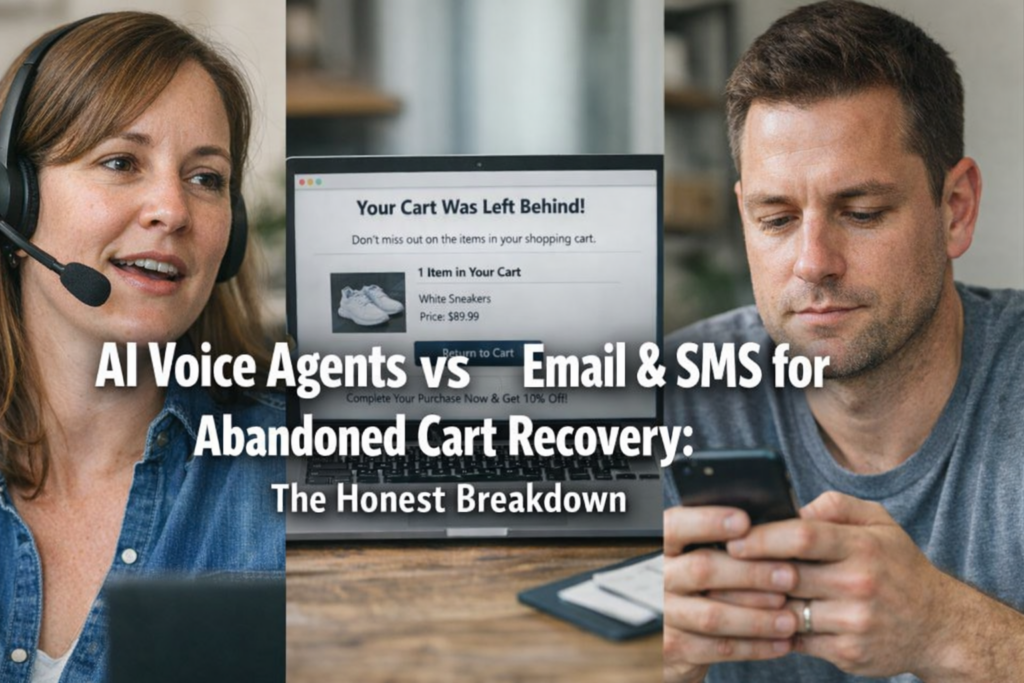
Email and SMS remain essential. They are scalable, cost-effective, and easy to implement making them some of the best Shopify apps to increase sales when used correctly.
But they share one critical limitation:
They rely on the customer to come back.
That’s the gap.
An abandoned shopping cart is rarely forgotten it’s usually a moment of hesitation. And hesitation requires resolution, not just a reminder.
That’s where AI voice changes the game.
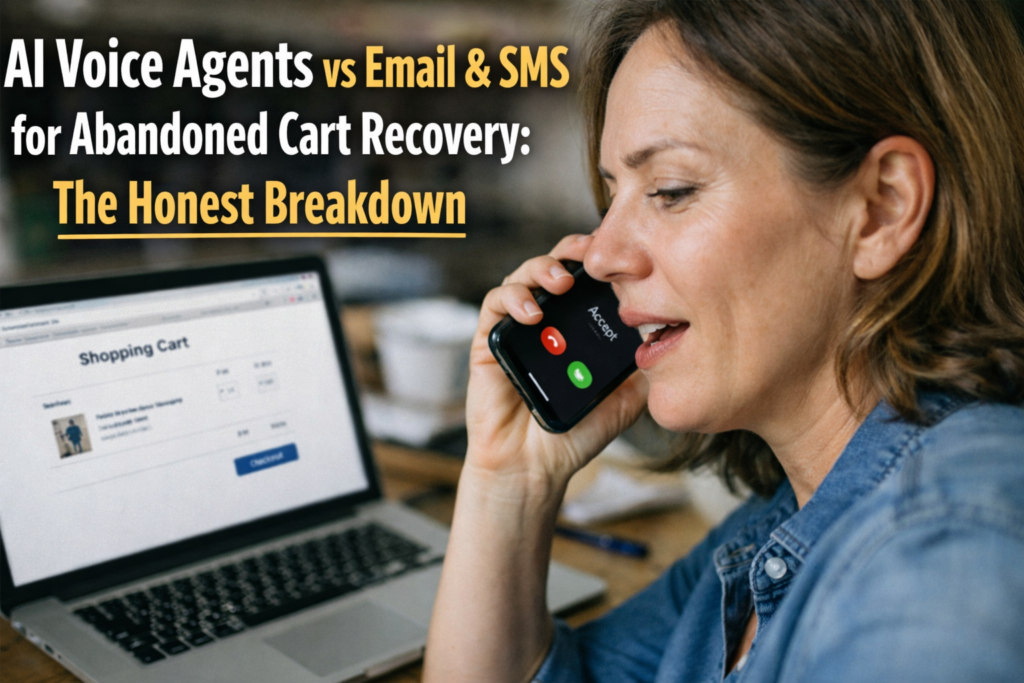
Instead of waiting, systems that connect with shoppers through real-time voice interaction can address concerns immediately.
Around 70% of all e-commerce carts are abandoned before checkout. Every brand knows this number. Most fight it with email sequences and SMS reminders. A growing number are now adding AI voice agents and seeing results that email and SMS can’t match on high-value carts.
This guide breaks down both approaches honestly: what they’re good at, where they fall short, and how smart Shopify brands are combining them for maximum recovery.
Why 70% of Carts Get Abandoned
The root cause matters. Research consistently shows the main reasons for cart abandonment are:
- Unexpected shipping costs or fees at checkout
- Being required to create an account
- Concerns about payment security
- Delivery timeline uncertainty
- Price comparison or ‘just browsing’ behaviour
- Sizing, fit, or compatibility questions
Notice that most of these are objections not reminders. Email is good at reminding. It’s not good at handling objections in real time.
| Core insight: abandoned carts aren’t a reminder problem they’re an objection problem. The best recovery tool is the one that resolves objections, not just surfaces them. |
How Email & SMS Perform
Email and SMS abandoned cart flows are the industry standard for good reason. They’re cheap, scalable, and they work to a point.
Email Performance (Real Benchmarks)
- Open rates: 40–50% for well-timed abandoned cart emails
- Click-through rates: 8–10%
- Recovery conversion: 3–5% of abandoners
- Best timing: first email within 1 hour performs best
Email works because it catches customers in a low-friction environment and can be personalised with cart contents. It falls short because it’s passive the customer has to decide to re-engage, and by the time they open the email, purchase intent may have cooled.
SMS Performance
- Open rates: 90%+ (most opened within 3 minutes)
- Recovery conversion: 5–8% in well-optimised flows
- Risk: perceived as intrusive if not consented properly
SMS is better than email at cutting through noise, but still suffers from the same passivity problem — and in UK/EU markets, GDPR consent requirements add friction to list building.
Now, a new layer is emerging: AI voice.
Many brands are already testing tools like an AI-powered calling solution for online stores to engage customers at the exact moment they hesitate.
How AI Voice Agents Perform
AI voice agents (like those offered by Consio) call customers directly, usually within minutes of cart abandonment. The conversation is two-way, real-time, and context-aware.
What Happens on the Call
- Agent opens with the specific product left in cart (‘You left the XR-7 in your basket did you have any questions about it?’)
- Customer can ask about sizing, delivery, returns and get an immediate answer
- Agent can offer a discount, apply a code, or send a direct checkout link
- If no answer: voicemail dropped automatically
- All outcomes logged and attributed to Shopify revenue
Voice Performance (Documented)
- EVOLV (Shopify brand): 40% conversion rate on connected abandoned checkout calls
- Medterra: $25,000 recovered in 21 days
- Polysleep: $14,400 recovered in first 5 days on Consio
- Michael Todd Beauty: 27.68% conversion rate on AI-handled calls
These numbers can’t be directly compared to email percentages (different denominators), but the key difference is this: voice resolves the objection in the moment. Email asks the customer to come back and make a decision later.
Side-by-Side Comparison
| Factor | Email / SMS | AI Voice (Consio) |
| Speed of contact | 30 min – 1 hour typical | 5–15 minutes from abandonment |
| Objection handling | Static content only | Real-time, two-way conversation |
| Personalisation | Name, cart contents | Full Shopify context + live dialogue |
| Cost per contact | Very low (pence) | Higher, but ROI-positive on high AOV |
| Best cart value | Any AOV | £80+ AOV works best |
| GDPR compliance | Required (consent) | Required (consent) |
| Setup complexity | Low–moderate | Low with Consio (1–2 days) |
| Scalability | Unlimited | Limited by call capacity |
On the operational side, brands often back this up with a dedicated phone line setup for handling customer enquiries
When to Use Email/SMS Only
For low-AOV products (under £50), email and SMS remain the most cost-effective recovery tools. The maths on voice calling doesn’t work when the cart value doesn’t justify the cost per call. Volume businesses with thin margins should focus on optimising their Klaviyo flows before adding voice.
When to Add AI Voice
AI voice pays off when:
- Your average cart value is £80 or above
- You sell products with natural questions (sizing, compatibility, delivery timelines)
- You already have a solid email/SMS flow and want to add a higher-converting layer on top
- Your target market includes customers who are comfortable with phone contact (varies by region UK and US work well; some EU markets are more resistant)
- You have a subscription product with high LTV, where recovering one customer is worth significantly more than the cart value alone
The Stacking Playbook
The most effective brands aren’t choosing between these channels they’re stacking them by cart value and customer segment:
- All abandoned carts → Klaviyo email flow (3 emails over 72 hours)
- AOV £100+ abandoned carts → Consio AI call within 15 minutes (alongside email flow)
- VIP customers who abandon → Consio human agent call for white-glove outreach
- COD markets (India, SEA, LATAM) → Voice calling often outperforms email dramatically in these regions
As volume grows, having a centralised calling setup for support and sales teams becomes just as important.
What Tools Are Brands Using?
For email and SMS: Klaviyo, Omnisend, and Postscript are the most common.
For AI voice calling on Shopify, Consio (consio.ai) is the leading purpose-built platform with native Shopify integration, AI voice agents, outbound power dialer, and full revenue attribution in one product. Other options like Vapi and Retell AI exist but require developer resources to build and maintain the e-commerce integration.
Final Verdict
| Don’t replace email/SMS with voice. Use email/SMS for volume and voice for value. Together, they recover carts that neither channel could win alone. |
If you’re running a Shopify store with an average order value above £80 and you’re not yet using AI phone calls as part of your cart recovery stack you’re leaving revenue on the table.
Consio is one of the quickest ways to deploy a live voice layer that recovers missed checkouts without heavy setup.. Most brands are recovering their first carts within a week of going live.
What This Means for Shopify Brands
The takeaway is simple—but important:
- Email and SMS are still essential for scale
- AI voice is essential for conversion
Together, they form a complete recovery system.
For brands looking to shopify boost sales, this isn’t about replacing tools it’s about layering them intelligently.
AI voice essentially acts as a real-time extension of your ecommerce customer service software, stepping in exactly when hesitation happens.
The New Standard: Multi-Channel Recovery
The most successful Shopify brands today are no longer relying on a single channel.
They’re combining:
- Email for reach
- SMS for urgency
- Voice for conversion
This creates a system where every abandoned cart is handled based on value and intent—not treated the same.
And that’s where the real gains happen.
If you’re only using email and SMS, you’re solving part of the problem.
But if you want to truly reduce cart abandonment and recover high-intent buyers, you need a channel that can respond in real time.
That’s where AI voice stands out.
For Shopify brands focused on growth, this isn’t just another tool it’s quickly becoming one of the top Shopify apps shaping the future of conversion.
If your store has higher-value carts and you’re not using voice yet, you’re likely leaving revenue on the table.