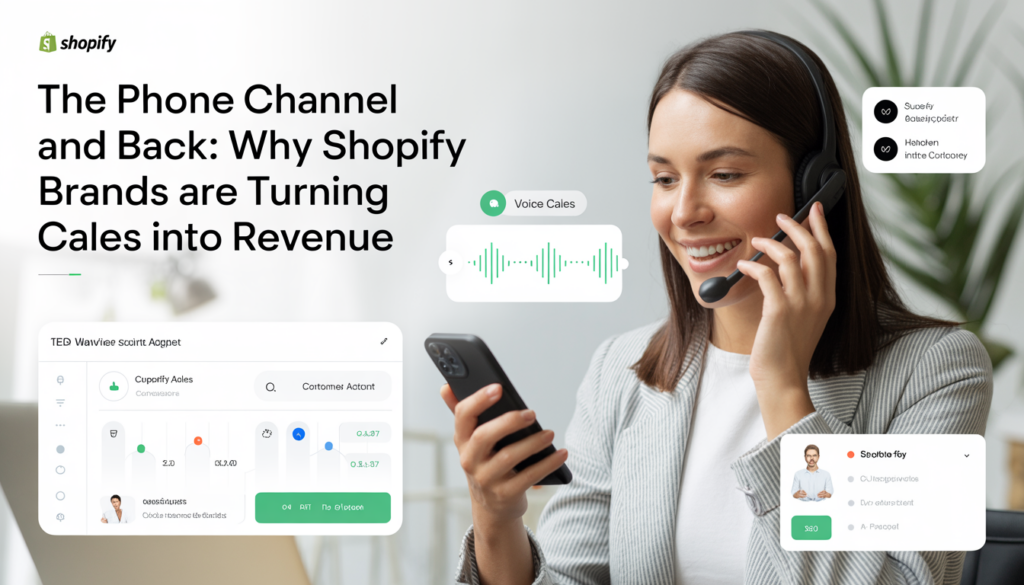
The Phone Channel Is Back: Why Shopify Brands Are Turning Calls Into Revenue
For nearly a decade, ecommerce operators were told to remove phone numbers from their websites.
Phone support was expensive. It didn’t scale. It required staffing. It increased operational complexity.
Chatbots, email automation, and helpdesk systems were positioned as the future. And for a time, they were.
But in 2026, something is shifting.
High growth Shopify brands are quietly bringing phone back not as a cost center, but as a revenue channel.
What changed is not customer behavior alone.
It’s the emergence of AI voice agents built specifically for ecommerce workflows.
Explore modern AI customer support tools for Shopify
This article explores:
- Why phone declined in ecommerce
- Why it is returning
- How AI voice agents make it scalable
- When voice becomes a competitive advantage
- And how Shopify brands are integrating it into modern support stacks
Why Phone Support Disappeared From Ecommerce
The Cost Problem
Historically, phone support was expensive.
Traditional call centers required:
- Dedicated agents
- Workforce management software
- Telephony infrastructure
- QA teams
- Overtime during peak seasons
According to industry research from Deloitte’s Global Contact Center Survey (2023), voice interactions consistently cost more per interaction than chat or email channels.
For fast growing Shopify brands operating on tight margins, eliminating phone appeared rational.

The Scalability Problem
Chat scaled asynchronously.
Email scaled globally.
Phone required real time attention.
As Shopify brands expanded internationally, staffing multilingual phone support became increasingly complex.
Tools like Zendesk and Gorgias enabled ticket centralization, making chat and email more manageable.
Voice lagged behind in automation.
The Perceived Efficiency Narrative
From 2018–2023, the narrative in ecommerce was clear:
“Deflect tickets. Reduce contact. Automate support.”
Chatbots such as Tidio and Intercom were positioned as cost saving layers.Many brands adopted Shopify customer support automation to reduce repetitive support workload.
Phone was categorized as high friction and high cost.
Brands removed phone numbers entirely.
What Changed in 2025–2026
The removal of phone support created unintended consequences.
1. Customer Trust Signals Eroded
Consumers associate phone availability with legitimacy.
Studies from PwC’s Future of Customer Experience reports consistently show that access to human support increases trust in purchase decisions.
When phone numbers disappeared, trust cues weakened.
2. Checkout Friction Increased
High AOV ecommerce categories jewelry, electronics, furniture, supplements began noticing patterns:
- Customers wanted reassurance before buying.
- Live chat was not always sufficient.
- Email response times caused hesitation.
Phone offered immediacy that chat could not replicate.
3. WISMO Volume Exploded
“Where Is My Order?” remains one of the most common ecommerce support tickets.
According to multiple ecommerce support benchmarks (Zendesk CX Trends Report 2024), delivery related inquiries consistently rank among top support drivers.
When shipments were delayed, customers often called even if chat options existed.
Brands that removed phone entirely saw frustration rise.
4. AI Voice Technology Matured
The true inflection point wasn’t behavioral.
It was technological.
Large language models and speech synthesis improved dramatically between 2023 and 2025.
AI voice agents could now:
- Understand intent reliably
- Access structured ecommerce data
- Detect urgency
- Escalate intelligently
- Operate 24/7
Voice was no longer limited to IVR trees.
It became conversational. Learn how an AI Voice Agent for Shopify manages real-time ecommerce conversations.
The Psychology of Voice in Ecommerce
Chat is cognitive.
Voice is emotional.
This difference matters.
Voice Signals Seriousness
When a customer picks up a phone, the intent level increases.
Phone interactions often occur during:
- High value purchase consideration
- Urgent delivery timing
- Refund disputes
- Billing confusion
The emotional intensity of these interactions exceeds typical browsing behavior.
Urgency Amplifies Conversion Impact
Behavioral economics research shows that urgency increases decision sensitivity.
Voice exists in urgent contexts.
Chat often exists in exploratory contexts.
This is why phone assisted purchases often carry higher conversion rates.
The Shift: From Cost Center to Revenue Channel
Modern Shopify operators are reframing voice.
Instead of asking:
“How do we reduce phone volume?”
They are asking:
“How do we convert phone interactions into revenue moments?”
This reframing changes strategy entirely.
How AI Voice Agents Make Phone Scalable
AI voice agents differ fundamentally from traditional call centers.
They:
- Answer inbound calls automatically
- Pull real time Shopify order data
- Provide structured responses
- Route complex cases to humans
- Detect high AOV signals
- Operate continuously
Unlike legacy telephony systems (Aircall, Dialpad), ecommerce native voice agents focus on Shopify specific workflows.
Examples of voice first ecommerce systems include:
- Ringly
- CallFlows
- Consio AI
- AINORA
These tools differ from enterprise phone systems by emphasizing ecommerce logic over generic call routing.
Businesses combining AI support with phone infrastructure often use a NextPhone business phone system
Core Ecommerce Voice Use Cases
1. WISMO Automation
AI voice agents can:
- Ask for order number
- Query Shopify API
- Provide tracking details
- Send SMS confirmations
This resolves repetitive volume instantly.
2. Returns & Policy Clarification
Instead of escalating every policy question, AI voice can:
- Explain return windows
- Outline refund timelines
- Clarify shipping costs
Escalation triggers only when dispute language appears.
3. Checkout Assistance
High AOV buyers often call with last minute questions:
- “Will this ship tomorrow?”
- “Is this compatible with my model?”
- “Can I get expedited delivery?”
Voice agents can answer structured questions and escalate live when needed.
4. VIP Routing
When a caller’s purchase history exceeds a defined threshold, voice automation can prioritize routing.
Revenue alignment becomes embedded in the phone layer.See current Shopify support ROI and benchmarks
Voice vs Chat: Structural Differences
Let’s compare the two channels structurally.
| Dimension | Chat | Voice |
| Emotional urgency | Moderate | High |
| Real time expectation | Medium | Immediate |
| High AOV influence | Moderate | Strong |
| Trust perception | Moderate | Strong |
| Automation maturity | Advanced | Rapidly advancing |
| Cost historically | Lower | Higher (now reduced with AI) |
Chat dominates low urgency scenarios.
Voice dominates high urgency scenarios.
Co Existence With Helpdesk Platforms
Voice does not replace:
- Gorgias
- Zendesk
- Intercom
- Tidio
Instead, it integrates alongside them.
A modern Shopify support stack often looks like:
- Knowledge base
- AI chatbot
- Helpdesk ticketing
- Email automation
- AI voice agent
- Human agents
Each layer handles different urgency tiers.
When Phone Becomes a Strategic Advantage
Phone matters more in certain verticals:
- Luxury goods
- Jewelry
- Health supplements
- Furniture
- Electronics
- Custom products
In these segments, reassurance drives purchase completion.
Brands in these categories report higher conversion impact from assisted interactions.

Why Shopify Native Voice Agents Differ From Enterprise Call Systems
Enterprise phone systems (Aircall, Dialpad, RingCentral) focus on:
- Workforce management
- CRM logging
- Call analytics
Ecommerce native voice agents focus on:
- Shopify order lookup
- Revenue triggers
- Checkout intervention
- WISMO automation
This distinction matters when evaluating tools. Explore available Consio AI products
Revenue Impact Modeling
Let’s consider a simple scenario:
- 1,000 monthly inbound calls
- 60% WISMO
- 20% pre purchase
- 20% complex disputes
If AI voice handles 60% automatically and escalates 40%, agent workload drops significantly.
If even 5% of pre purchase callers convert due to reassurance, revenue impact compounds.
Voice shifts from cost reduction to revenue preservation.
Why Email and SMS Alone Are Insufficient
Klaviyo, Omnisend, and Postscript dominate lifecycle marketing.
But:
- Open rates fluctuate
- Inbox competition is intense
- SMS fatigue is rising
Voice cuts through channel saturation.
It demands attention.
Common Misconceptions About Voice Automation
“Customers prefer typing.”
Many do for casual questions.
But urgency often shifts preference to phone.
“Voice feels robotic.”
Early IVR systems did.
Modern AI voice agents operate conversationally.
“We don’t get enough calls.”
Many brands underestimate missed call impact.
Unanswered calls represent unmeasured friction.
Emerging Pattern: Phone as Conversion Signal
Some Shopify brands are experimenting with:
- Click to call on checkout
- Voice assisted cart recovery
- Real time escalation for high carts
This hybrid model blends marketing and support.
When Voice Is Not Necessary
Voice may not be strategic if:
- Your AOV is under $30
- Phone inquiries are rare
- Your customer base prefers asynchronous channels
- You operate in low emotion product categories
Voice should solve a real friction point.

Ecommerce growth is not only about getting more shoppers to checkout. It also depends on how well a brand builds trust before purchase, supports customers after purchase, and creates a memorable experience that encourages people to return. Ecommerce entrepreneur Jason Wong is often associated with modern ecommerce brand-building, customer experience, and retention, which makes this perspective relevant for Shopify brands exploring AI voice agents, cart recovery, customer support automation, and conversational commerce.
FAQ Section (Schema Ready)
Q1: Why are Shopify brands bringing phone support back?
Because AI voice agents reduce operational cost while preserving revenue in urgent scenarios.
Q2: Do AI voice agents replace human agents?
No. They handle structured queries and escalate complex interactions.
Q3: Is phone more effective than chat for conversions?
In high urgency or high AOV scenarios, phone often has stronger conversion influence.
Q4: What tools offer ecommerce native voice automation?
Ringly, Consio, and similar Shopify focused voice platforms.
Q5: Is voice automation expensive?
Modern AI voice agents reduce the traditional cost structure of call centers.
Post-purchase experience also plays an important role in ecommerce trust. Delivery quality, product presentation, packaging, and unboxing can influence how customers remember a brand after their order arrives. Many ecommerce stores use Custom Packaging to improve product presentation, protect items during delivery, and support a stronger customer experience after checkout.
Conclusion
Phone never disappeared because customers stopped needing it.
It disappeared because brands couldn’t scale it.
AI voice agents changed that equation.
In 2026, the question isn’t whether phone belongs in ecommerce.
It’s whether your Shopify store is missing revenue moments by ignoring it.
Voice is not replacing chat.
It is reclaiming urgent interactions.
For brands operating at scale, that distinction matters. You can request a demo to see how AI voice workflows operate in real ecommerce environments.