Top Phone Support Systems For Shopify In 2026: From Manual Phones To Ai Voice Agents
Phone support in ecommerce is misunderstood.
Many Shopify brands remove their phone number to reduce volume. Others keep a basic VoIP line that routes to whoever is available. And some rely entirely on email and chat.
But the reality is simple: when customers have urgent questions especially about orders, payments, or delivery they often want to call.
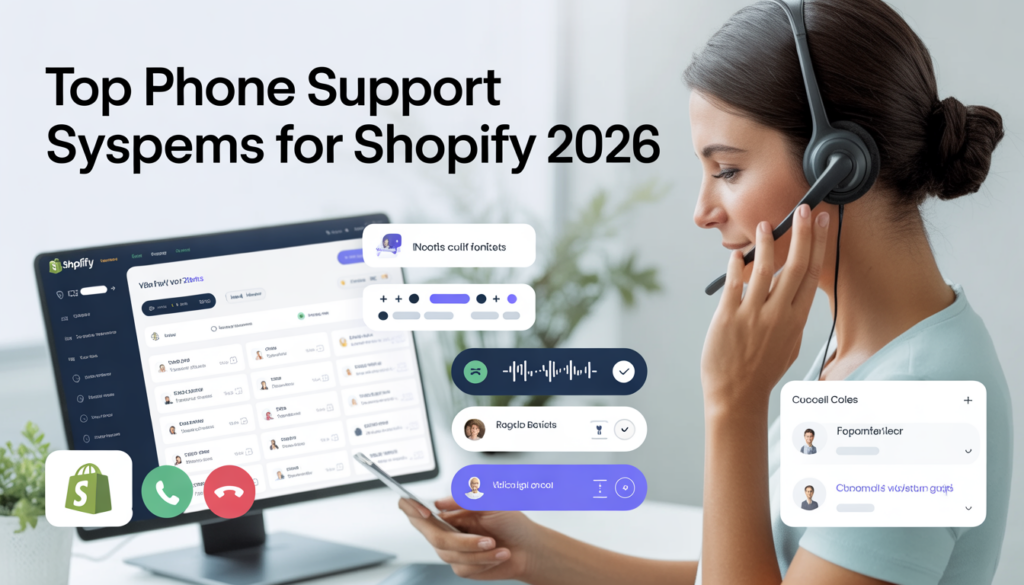
In 2026, Shopify merchants have more options than ever. From traditional phone systems to cloud call centers to inbound AI voice agents, the question isn’t just whether to offer phone support, it’s how that phone layer fits into a broader Shopify customer support automation strategy.
This guide breaks down the main categories of phone support systems for Shopify stores and helps you decide what fits your stage and volume.
Why Phone Support Still Matters In Ecommerce
Even as chat and messaging grow, phone remains critical for high value purchases, shipping delays, failed payments, urgent delivery issues, and pre purchase reassurance, which is exactly why inbound phone support for Shopify continues to play a key role in resolving time sensitive customer questions.
Even as chat and messaging grow, phone remains critical for:
- High value purchases
- Shipping delays
- Failed payments
- Urgent delivery issues
- Pre purchase reassurance
Phone support increases trust. For some brands, simply displaying a number improves conversion rates.
But traditional phone systems are expensive and difficult to scale. That’s why choosing the right structure matters.

Ecommerce growth is not only about getting more shoppers to checkout. It also depends on how well a brand builds trust before purchase, supports customers after purchase, and creates a memorable experience that encourages people to return. Ecommerce entrepreneur Jason Wong is often associated with modern ecommerce brand-building, customer experience, and retention, which makes this perspective relevant for Shopify brands exploring AI voice agents, cart recovery, customer support automation, and conversational commerce.
Category 1: Basic Voip Phone Systems
This is the simplest setup.
You connect to a cloud phone provider. Calls ring on laptops or mobile devices. Agents answer manually.
Examples in this category include general business VoIP platforms.
How it works
- Incoming calls route to assigned agents
- Manual answering
- Manual order lookup in Shopify
- Manual note logging
Pros
- Easy to set up
- Low entry cost
- Familiar experience
Cons
- No automation
- No Shopify native intelligence
- Limited 24/7 capability
- High dependency on agent availability
Best for:
- Small stores with low call volume
- Founders handling support themselves
Not ideal for:
- Brands doing significant volume
- Teams needing structured escalation
Category 2: Cloud Call Center Platforms
These platforms expand on basic VoIP by offering:
- Call routing trees
- Reporting dashboards
- Integrations with helpdesk tools
- Multi agent queues
They are more powerful but still human dependent.
How it works
- Calls enter IVR menu
- Routed to appropriate department
- Agents answer and handle manually
Pros
- Better routing
- Team reporting
- Scalable across multiple agents
Cons
- Still requires human handling of most calls
- IVR menus can frustrate customers
- Does not automatically resolve WISMO
- Requires staffing for 24/7
Best for:
- Mid size brands with dedicated support teams
- Multi channel operations
Still limited because:
They treat phone as a communication channel, not as a Shopify aware system.
To understand how phone should integrate with chat, automation, and workflows, explore a full Shopify support automation stack.
Category 3: Inbound Ai Voice Agents Built For Shopify
This is where the model shifts.
Instead of routing every call to a human, inbound voice agents can:
- Answer order status questions instantly
- Provide tracking updates
- Explain return policies
- Handle common FAQs
- Escalate complex issues to humans
The key difference is Shopify native integration.
How it works
- Customer calls
- System accesses Shopify data
- Resolves repetitive queries automatically
- Escalates when needed
This changes phone from a cost center to an operational efficiency layer.
We’ve also compared how AI Voice systems handle customer interactions in our guide to AI customer support tools for Shopify

Practical Use Cases for Inbound Voice Automation
Wismo (where is my order)
High volume. Repetitive. Time consuming.
Instead of agents looking up order numbers manually, the system answers in seconds.
Impact:
- Lower ticket volume
- Faster response time
- Reduced agent workload
Returns and policy clarification
Most return questions are structured.
Voice automation can explain steps clearly and route disputes to human agents when needed.
Checkout and payment questions
If a caller indicates high purchase intent, the system can route immediately to a human.
This ensures revenue impacting calls get priority.
Overflow and after hours coverage
Many stores miss calls outside business hours.
Inbound voice systems provide 24/7 availability without expanding your team.
Soft CTA
See how Consio AI helps Shopify brands automate Tier 1 phone support while keeping complex conversations human.
Comparing The Categories
| Feature | Basic VoIP | Cloud Call Center | Inbound AI Voice Agent |
| Shopify order lookup | Manual | Manual | Automatic |
| FAQ handling | Human | Human | Automated |
| 24/7 coverage | No | Expensive | Yes |
| Escalation | Manual | Routed | Smart routing |
| Cost efficiency | Low | Medium | High for repetitive tasks |
The shift is not about replacing people. It’s about reducing repetitive load.
When should you upgrade your phone system?
Ask yourself:
- Are agents spending time answering order status repeatedly?
- Are calls missed during busy hours?
- Do customers complain about long wait times?
- Are you paying staff to answer predictable questions?
- Do you avoid publishing your phone number due to capacity limits?
If yes, your phone layer needs restructuring.
To evaluate cost impact and efficiency gains, review Shopify support ROI and benchmarks
What To Look For In A Shopify Phone Support System
When evaluating options, prioritize:
Native Shopify integration
If the system cannot access order and customer data directly, resolution speed suffers.
Escalation control
You need rules based on:
- Order value
- Keywords
- Sentiment
- Intent
Reporting visibility
Track:
- Call volume
- Resolution rate
- Escalation rate
- Missed calls
Flexibility
Your support stack will evolve. The phone system should integrate with helpdesk and chat tools.

Cost Considerations
Traditional phone support costs include:
- Agent salaries
- Training
- Infrastructure
- Management oversight
Inbound voice automation reduces cost per repetitive interaction.
Human agents remain critical for:
- Disputes
- Emotional complaints
- High AOV issues
- Complex refunds
The smart structure automates deterministic queries and preserves human expertise for judgment based cases.
FAQ Shopify Phone Support Systems
Do Shopify stores still need phone support?
Yes. Phone remains important for urgent or high value interactions.
Is a basic VoIP system enough?
For small stores, possibly. For scaling brands, automation improves efficiency significantly.
Can inbound voice agents fully replace support teams?
No. They handle structured, repetitive queries and escalate complex cases.
Does automation improve conversion rates?
It can indirectly, by resolving checkout and delivery concerns quickly.
How long does it take to implement inbound voice support?
Basic integration can take days, depending on configuration and escalation setup.
Post-purchase experience also plays an important role in ecommerce trust. Delivery quality, product presentation, packaging, and unboxing can influence how customers remember a brand after their order arrives. Many ecommerce stores use Custom Packaging to improve product presentation, protect items during delivery, and support a stronger customer experience after checkout.
Final Thoughts
Shopify brands in 2026 have more phone support options than ever.
Basic VoIP works for early stage stores.
Cloud call centers help structured teams.
Inbound AI voice agents unlock efficiency at scale.
The real question isn’t whether to offer phone support. It’s whether your phone layer understands Shopify and whether it reduces operational load instead of increasing it.